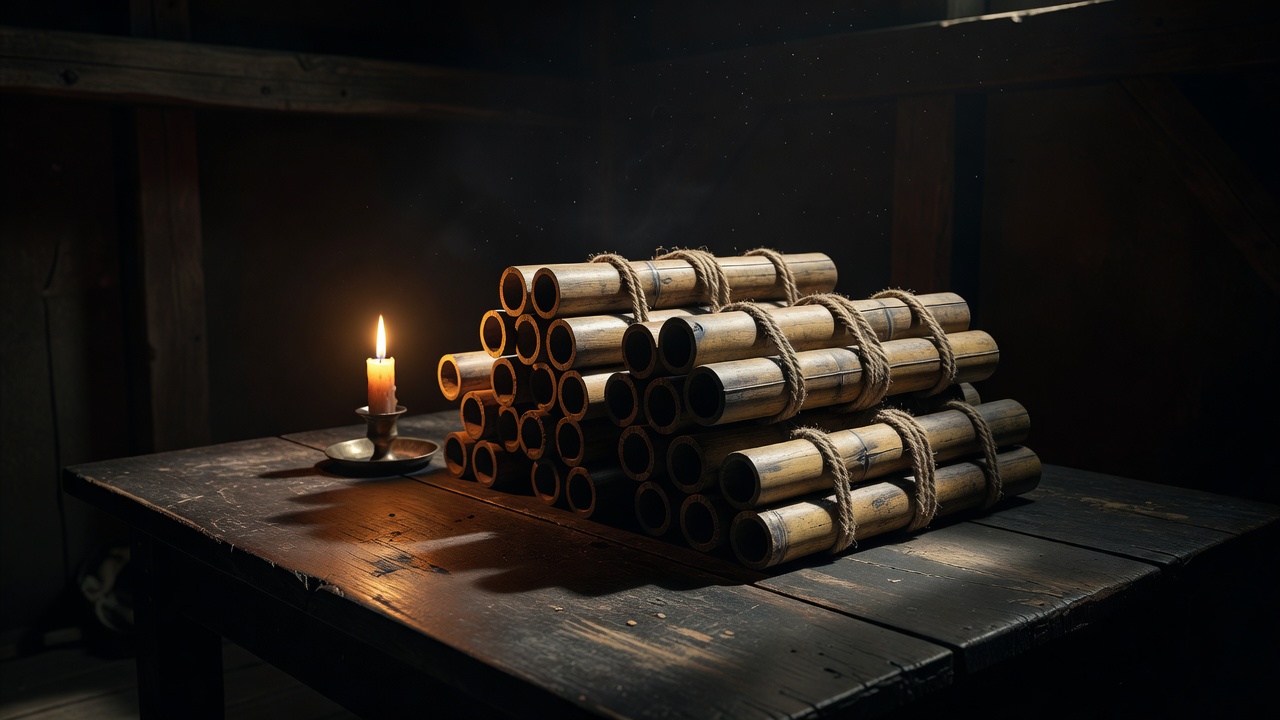
Step softly into the first room. The light is low because the earliest objects here are fragile, and because most of them survive only as drawings in old manuals. What they record is a quiet revolution: the moment someone noticed that a tube of burning powder, left open at one end, would try to fly.
Exhibit 1: The powder
Every rocket in this room begins with black powder, a mixture of saltpetre, charcoal and sulphur. The earliest surviving written formulae appear in the Wujing Zongyao, a Chinese military compendium completed in 1044 during the Song dynasty. At that stage gunpowder was an incendiary and an explosive; its use as a propellant came later and gradually, as artisans experimented with arrows that carried their own fire.
Historians still debate exactly when the self-propelled "fire arrow" (huojian) appeared, because the same word described arrows simply tied to burning packets. What is clear is that by the 13th century, true rockets were in use. Accounts of the Mongol siege of the Jin capital Kaifeng in 1232 describe flying fire weapons alongside the thunderous "heaven-shaking" bombs, and they are often cited as the first recorded military use of rockets.
Exhibit 2: The fire dragon
The Huolongjing, or "Fire Dragon Manual", compiled in the 14th century and attributed to Jiao Yu and Liu Bowen, is the gallery's most remarkable document. It illustrates rocket arrows launched in volleys from boxes and baskets, and a weapon called the "fire dragon issuing from the water": a tube that carried a first set of rockets, which on burning out ignited a second set inside its body. Whether it flew as reliably as the illustration suggests is uncertain, but the concept of staging is plainly on the page centuries before it became engineering doctrine.
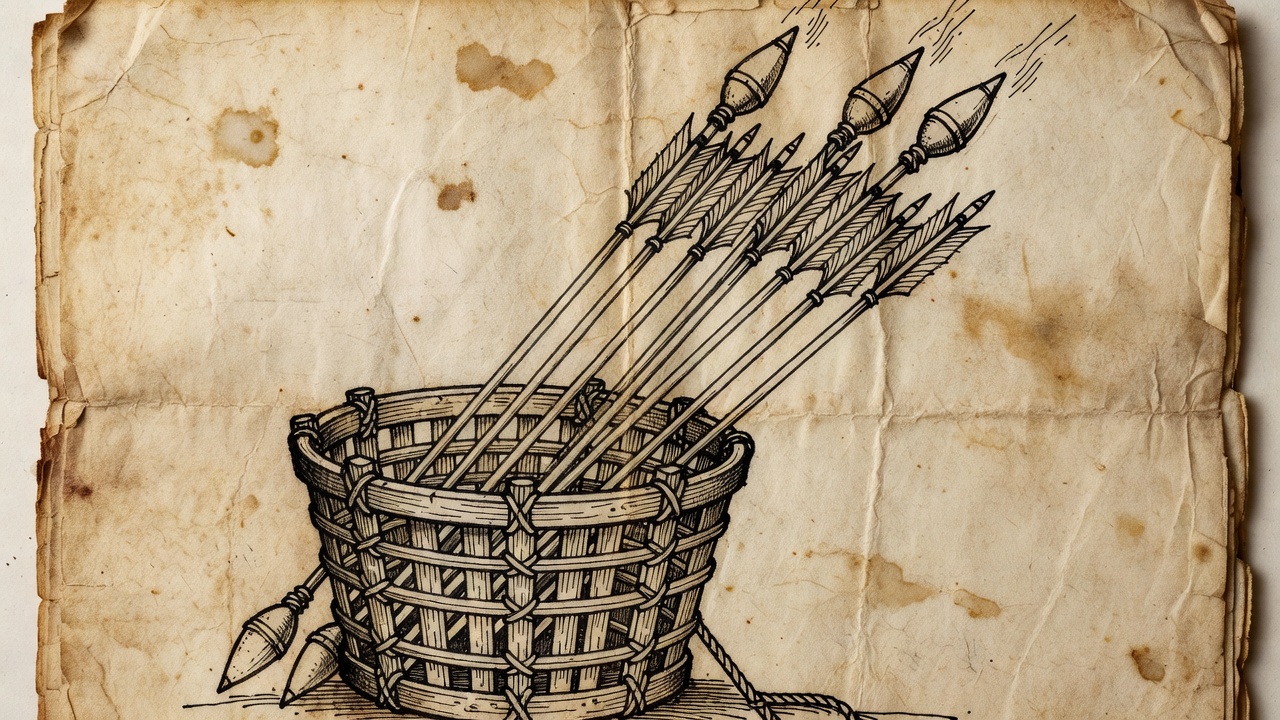
Exhibit 3: The legend of Wan Hu
Every gallery has an object whose label must say "attributed". Ours is Wan Hu, the official said to have strapped forty-seven rockets to a chair and vanished in smoke. The story is charming and widely repeated, but no early Chinese source records it; it appears to have taken shape in Western popular writing of the 20th century. We hang it here as folklore, clearly labelled. A crater on the far side of the Moon nonetheless bears his name.
Exhibit 4: The iron rockets of Mysore
Move now to southern India in the late 18th century. Under Hyder Ali and his son Tipu Sultan, the Kingdom of Mysore fielded rocket corps whose weapons used wrought-iron casings rather than paper or bamboo. The iron chamber tolerated higher pressures, which meant more thrust and longer range, reportedly up to about two kilometres. Bound to long bamboo or blade-tipped poles for stability, they were fired in mass volleys against East India Company troops, notably at the Battle of Pollilur in 1780.
After Tipu's death at the fall of Seringapatam in 1799, captured rockets were shipped to Britain and studied at the Royal Arsenal in Woolwich. Rusted examples of these casings have since been recovered in Karnataka, and they remain among the most evocative objects in the history of the rocket: crude, heavy and decisively ahead of their time.
Exhibit 5: Congreve's red glare
William Congreve, working at Woolwich, developed the Mysorean idea into a family of standardised military rockets from about 1804. Congreve rockets were used against Boulogne in 1806, during the bombardment of Copenhagen in 1807 and, most famously, in the British attack on Fort McHenry in Baltimore in September 1814. Watching from a ship in the harbour, Francis Scott Key wrote of "the rockets' red glare", a phrase now sung at every American ballgame.
Congreve's rockets were inaccurate, steadied by long wooden sticks. In 1844 William Hale patented a stickless design that spun the rocket using angled exhaust, a step toward the spin-stabilisation later used on artillery shells and small launch vehicles. As rifled artillery improved, war rockets faded from European arsenals, and the rocket waited for a new purpose. That purpose is in the next room.
Leaving Room I
What links these objects is not a single inventor but a long chain of imitation: China to the Islamic world and India, India to Britain, Britain to the Americas. Each copy was improved, and each improvement was made by someone who had seen the previous design in action, often from the receiving end.