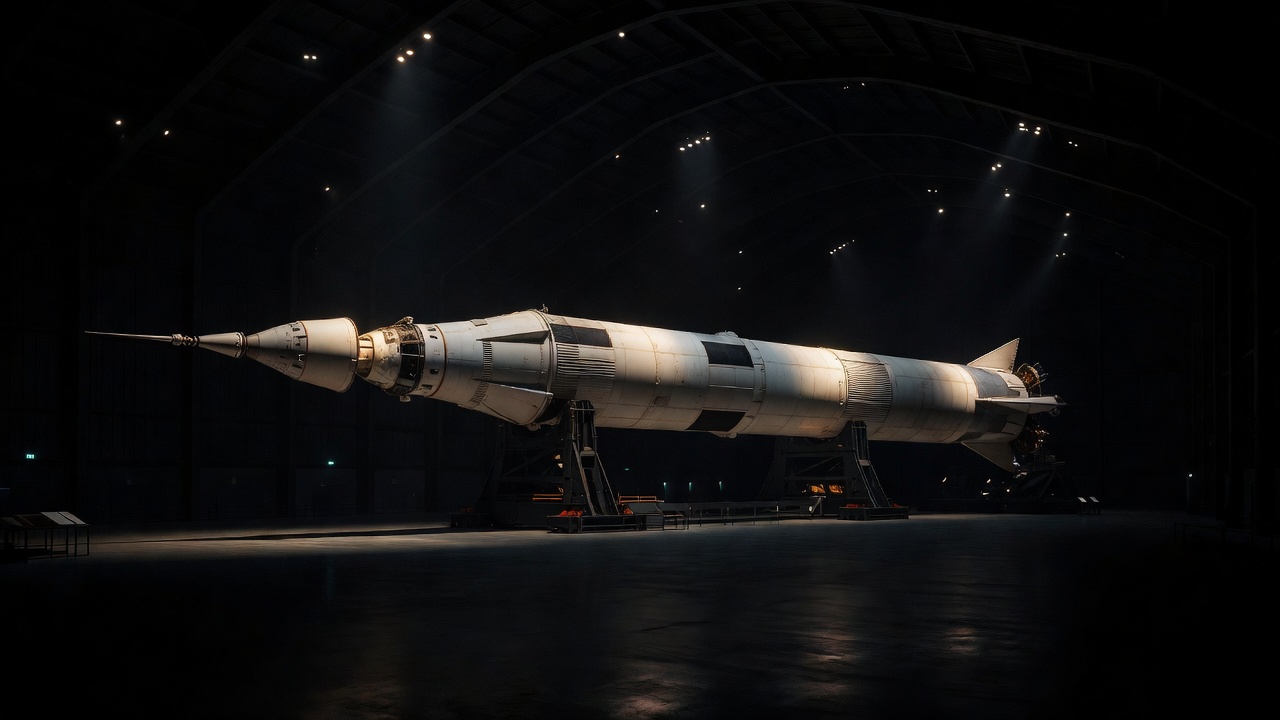
A rocket is built to be destroyed. Every one that survives to stand in a museum is either a spare, a test article, a reconstruction or a lucky accident. Knowing which is half the pleasure of a visit. Opening hours and displays change; always confirm with each museum before you travel.
The three Saturn Vs
Only three complete Saturn V vehicles exist, all in the United States and all assembled largely from flight-ready or test stages left over when the Apollo programme was cut short.
- Kennedy Space Center Visitor Complex, Florida. The Apollo/Saturn V Center displays a Saturn V horizontally, so you can walk the full 110 metres beneath its stages.
- Space Center Houston / Johnson Space Center, Texas. The Saturn V in the dedicated hall at Rocket Park includes stages intended for cancelled Apollo missions and has been carefully restored indoors.
- U.S. Space & Rocket Center, Huntsville, Alabama. Home to a Saturn V test vehicle designated a National Historic Landmark, a short drive from Marshall Space Flight Center, where the rocket was designed.
The Smithsonian
The National Air and Space Museum on the National Mall in Washington, D.C. holds some of Goddard's surviving rockets and early hardware. Its companion, the Steven F. Udvar-Hazy Center in Chantilly, Virginia, houses Space Shuttle Discovery among hundreds of aircraft and spacecraft. Both are free to enter.

Russia: Moscow and Kaluga
The Memorial Museum of Cosmonautics in Moscow sits beneath the soaring titanium Monument to the Conquerors of Space, unveiled in 1964. In Kaluga, the State Museum of the History of Cosmonautics, named after Tsiolkovsky and opened in 1967, displays Soviet spacecraft alongside material on the schoolteacher who lived nearby; his house is a separate memorial museum.
Germany: Munich and Peenemünde
The Deutsches Museum in Munich has displayed an A4/V-2 among its aerospace collections. On the Baltic coast, the Historical Technical Museum Peenemünde occupies the former power station of the wartime research site and presents the V-2 story together with the forced labour and destruction it caused. It is one of the most important, and most sobering, rocketry sites in Europe.
United Kingdom: London and Leicester
The Science Museum in London holds the reserve Black Arrow rocket, a sister of the Black Arrow that launched the Prospero satellite from Woomera, Australia, on 28 October 1971: still the only British satellite launched on a British rocket. The National Space Centre in Leicester stands out from afar thanks to its Rocket Tower, which houses a Blue Streak and a Thor Able.
France: Toulouse
Cité de l'Espace in Toulouse, near the heart of Europe's aerospace industry, displays a full-size Ariane 5 replica outdoors, together with a Mir space station mock-up that visitors can walk through.
How to look at a rocket
- Find the provenance. Is it flown hardware, a test article, a spare or a replica? Labels usually say, if you read the small print.
- Look at the base. Engine bells, turbopumps and plumbing reveal the propulsion method described in Room II.
- Count the joints. Each ring or seam usually marks a stage or tank boundary: the rocket equation made visible.
- Read the scars. Scorch marks, patched panels and stencilled part numbers are the closest thing a rocket has to a biography.