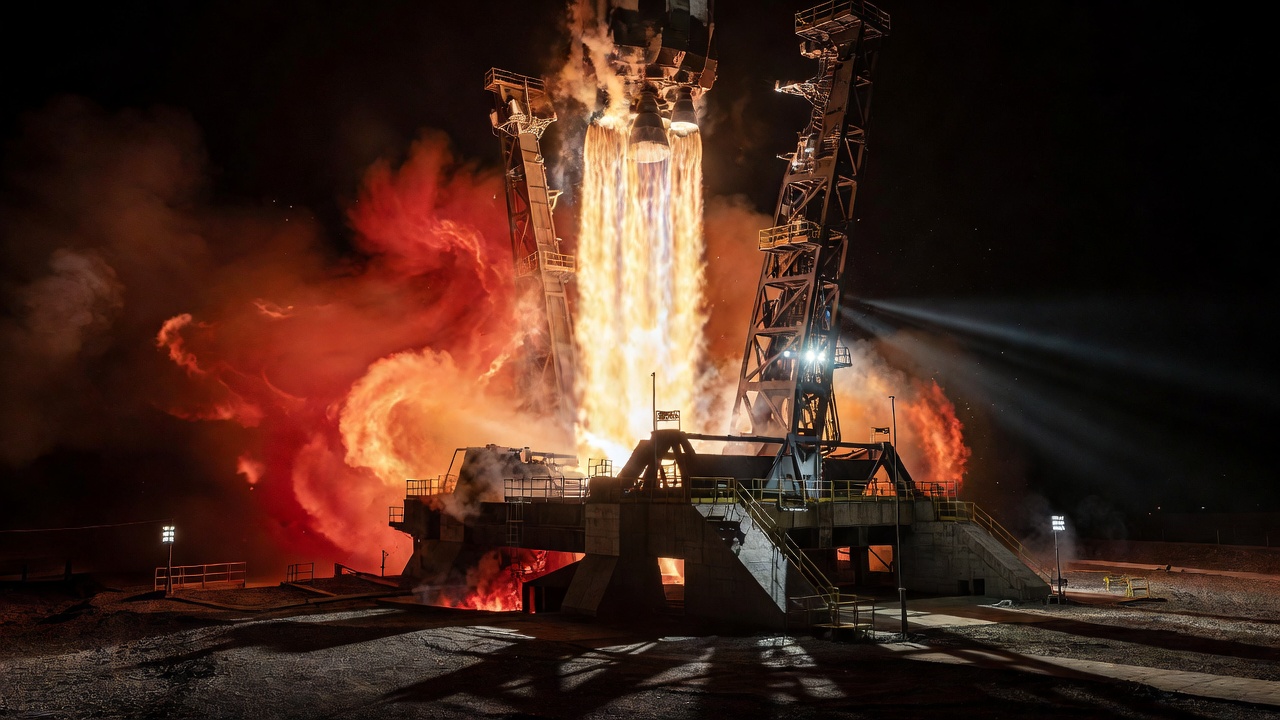
This room holds no single famous object. Instead its walls carry principles, each displayed like a specimen under glass. Understand these, and every rocket in the other rooms becomes legible.
Exhibit 1: The third law
Isaac Newton's third law of motion, published in the Principia in 1687, states that every action has an equal and opposite reaction. A rocket is the purest demonstration of it. Hot gas is expelled backward at high speed; the rocket is pushed forward. Nothing outside the rocket is needed to push against, which is why rockets work better, not worse, in the vacuum of space, where there is no air pressure behind the nozzle to oppose the exhaust.
This was precisely the point misunderstood in 1920, when a newspaper editorial scolded Robert Goddard for supposedly not knowing that a rocket needs air to push on. See the featured exhibit at the Entrance.
Exhibit 2: The rocket equation
In 1903 the Russian schoolteacher Konstantin Tsiolkovsky published the relationship that governs every launch: the change in velocity a rocket can achieve, Δv, equals its exhaust velocity multiplied by the natural logarithm of its starting mass divided by its final mass. Written out, Δv = ve ln(m0/mf).
The logarithm is the cruel part. Doubling the fuel does not double the speed; each extra unit of velocity costs more propellant than the last. Reaching low Earth orbit takes roughly 9 to 10 km/s of Δv once losses to gravity and drag are included, which is why most of a launch vehicle's mass on the pad is propellant.
Exhibit 3: Staging
The equation's harshness explains staging. Once a tank is empty, carrying it further is wasted effort, so rockets drop spent sections and continue lighter. The idea was sketched in the Huolongjing (see Room I) and formalised by Tsiolkovsky as "rocket trains". The Saturn V used three stages; the first, the S-IC, burned for about two and a half minutes before falling away into the Atlantic.
Exhibit 4: Four families of thrust
Propulsion methods are compared by specific impulse (Isp), measured in seconds: roughly, how long one unit of propellant can produce one unit of thrust. Higher is more efficient. Thrust and simplicity matter too, which is why no single family has won.
| Family | How it works | Typical Isp | Exhibit example |
|---|---|---|---|
| Solid | Fuel and oxidiser premixed in a rubbery grain; once lit, it burns to the end | ≈ 250–270 s | Space Shuttle Solid Rocket Boosters |
| Liquid | Fuel and oxidiser pumped from separate tanks into a combustion chamber | ≈ 300–450 s | RS-25 (liquid hydrogen and oxygen); F-1 (kerosene and oxygen) |
| Hybrid | Solid fuel with a liquid or gaseous oxidiser flowed over it | ≈ 230–280 s | SpaceShipOne, rubber fuel and nitrous oxide, 2004 |
| Electric (ion) | Ions accelerated by electric fields; tiny thrust, extreme efficiency | ≈ 1,500–4,000 s | NSTAR thruster, Deep Space 1, 1998 |
Exhibit 5: Goddard's liquid leap
Liquid propulsion owes its first flight to Robert Goddard, who on 16 March 1926 launched a rocket burning gasoline and liquid oxygen at Auburn, Massachusetts. Liquids are harder to handle than solids, needing pumps, valves and often cryogenic storage, but they can be throttled, shut down and restarted. That control is why liquid engines carried crews to the Moon and why most orbital boosters still use them.
Exhibit 6: The edge of space
Finally, a line drawn in air. The Kármán line, set at 100 kilometres altitude by the Fédération Aéronautique Internationale, is the conventional boundary of space. The first human-made object to cross it was a German A4, better known as the V-2, in June 1944: a reminder, hung deliberately in this gallery, that the methods on these walls were first proven as weapons.