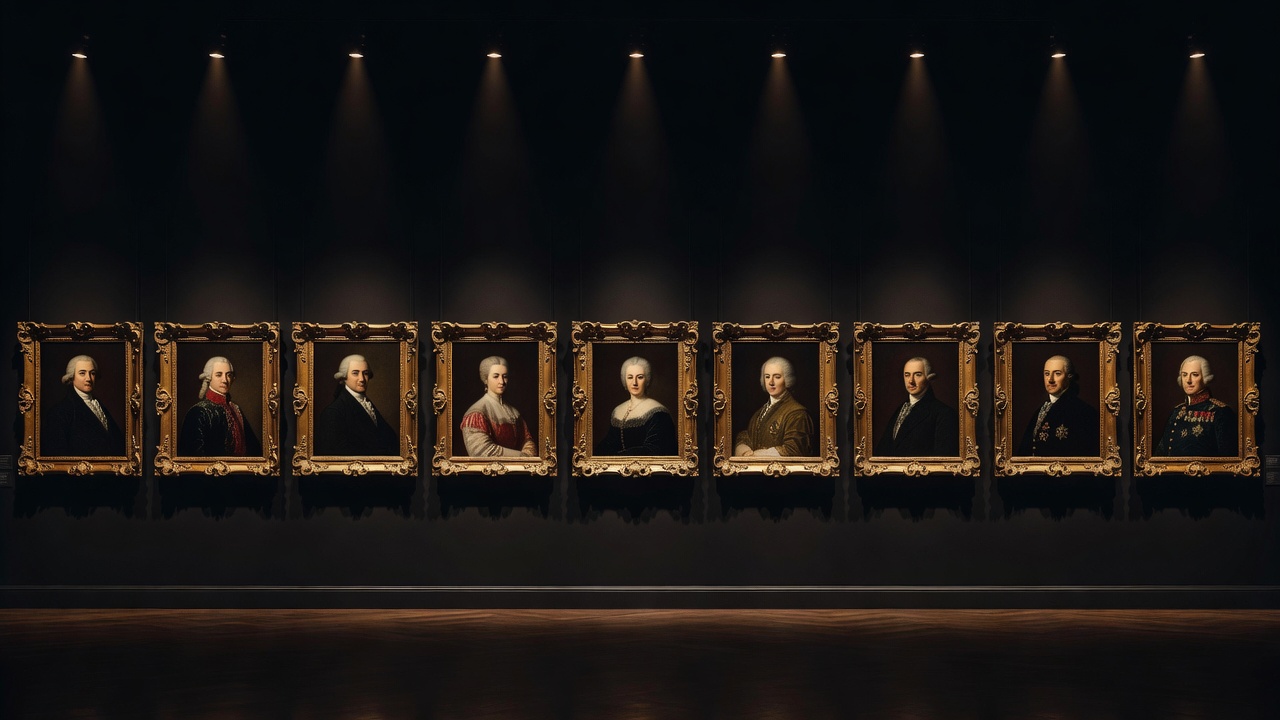
Portrait rooms flatter their sitters. This one tries not to. Each figure here changed the rocket's direction; several also lived in the shadow of war and state secrecy, and their labels say so.
Konstantin Tsiolkovsky (1857–1935)
Left largely deaf by childhood scarlet fever, Tsiolkovsky educated himself in Moscow's libraries and spent most of his life as a provincial schoolteacher in Borovsk and then Kaluga. In 1903 he published The Exploration of Cosmic Space by Means of Reaction Devices, which set out the rocket equation, argued for liquid hydrogen and oxygen as propellants and imagined multistage "rocket trains". He never built a large rocket. His most quoted line, that Earth is the cradle of humanity but one cannot live in the cradle forever, comes from a 1911 letter. His house in Kaluga is now a museum.
Robert H. Goddard (1882–1945)
A physics professor at Clark University in Worcester, Massachusetts, Goddard patented both liquid-fuelled and multistage rocket designs in 1914. His 1919 Smithsonian monograph, A Method of Reaching Extreme Altitudes, speculated that a rocket could reach the Moon, prompting public ridicule. On 16 March 1926 he launched the first liquid-fuelled rocket at Auburn. With support from Charles Lindbergh and the Guggenheim family he moved to Roswell, New Mexico, in 1930, testing gyroscopic stabilisation and ever-larger rockets. He worked largely alone and published sparingly, which limited his influence in his lifetime.
Hermann Oberth (1894–1989)
Born in Hermannstadt (Sibiu) in Transylvania, Oberth had his doctoral dissertation on rocketry rejected, and published it anyway in 1923 as Die Rakete zu den Planetenräumen ("The Rocket into Planetary Space"). The book became a sensation among German enthusiasts and helped spark the amateur Verein für Raumschiffahrt. Oberth served as scientific adviser on Fritz Lang's 1929 film Frau im Mond, which popularised the launch countdown. A young member of his circle was Wernher von Braun.
Robert Esnault-Pelterie (1881–1957)
An aviation pioneer who introduced the aircraft control stick, Esnault-Pelterie turned to spaceflight theory in the 1910s and 1920s and helped popularise the French word astronautique. With banker André Hirsch he funded an international astronautics prize, the REP-Hirsch Prize, awarded first to Oberth in 1929.
Sergei Korolev (1907–1966)
Imprisoned during Stalin's purges and sent to the Kolyma labour camps, Korolev was later returned to design work and became the Soviet programme's Chief Designer. His R-7, the first intercontinental ballistic missile, launched Sputnik 1 on 4 October 1957 and Yuri Gagarin on 12 April 1961. His identity was a state secret; the world learned his name only from his obituary in January 1966.
Wernher von Braun (1912–1977)
Von Braun led technical development of the A4/V-2 at Peenemünde. The missile killed thousands of civilians, and many thousands more prisoners died building it in the underground Mittelwerk factory, supplied from the Mittelbau-Dora concentration camp. After 1945 he was brought to the United States, where he led the team behind the Redstone and Jupiter-C rockets and, at NASA's Marshall Space Flight Center in Huntsville, the Saturn V. Both parts of this portrait belong on the same wall.
Mary Sherman Morgan (1921–2004)
A chemist at North American Aviation's Rocketdyne division, Morgan formulated Hydyne, the fuel that powered the Jupiter-C first stage that launched Explorer 1, the first American satellite, on 31 January 1958. She received little public credit in her lifetime; her story was later told by her son, the writer George D. Morgan.